Verve
A connected platform of mobile business tools designed to simplify everyday work for small teams.
Interested in this project?
Have a question or want to know more about the work behind it?
Ask about this project →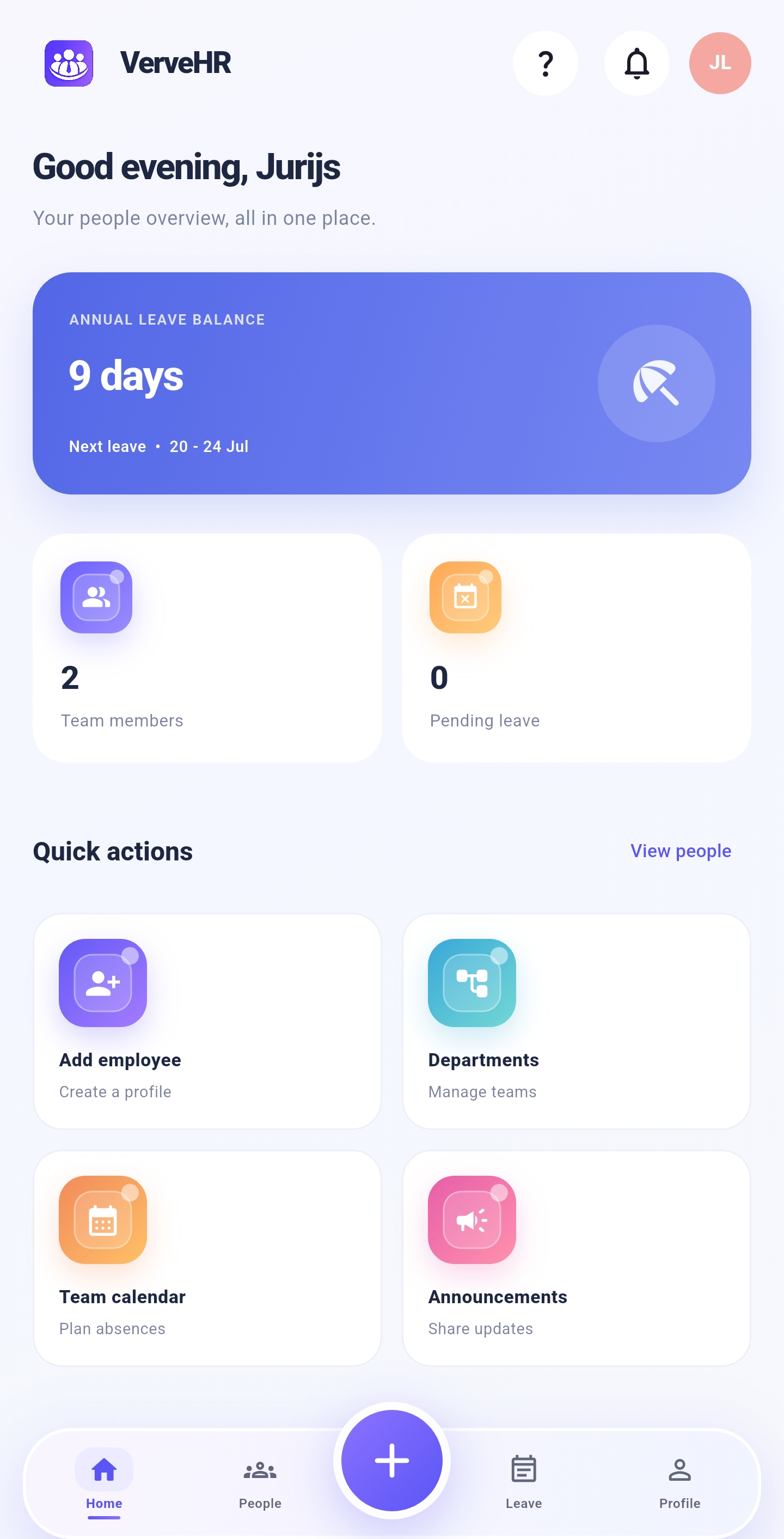
01 — Overview
One connected ecosystem of digital tools for the day-to-day work of small businesses.
Verve is an independently developed software platform intended to simplify everyday business operations. Rather than relying on multiple disconnected solutions, the platform is being developed to bring together a set of mobile applications built around a shared architecture and consistent principles of interaction.
At its core, Verve follows the concept of a modular ecosystem: each tool focuses on a defined set of tasks while remaining part of a connected system. This approach is intended to allow the platform to expand over time, maintaining a consistent user experience without introducing unnecessary complexity for smaller organisations.
The project is developed independently using Flutter and Dart. Particular attention is given to architecture, reliability, security and ease of everyday use.
Verve is currently in active development. The platform is progressing through defined stages of functionality implementation, testing and preparation for a future release.
02 — The Challenge
Small businesses need effective digital tools, but software complexity should not become another burden on their operations.
Day-to-day business activities involve many interconnected processes, including employee management, handling requests, organising tasks, tracking resources and sharing information. Separate software solutions exist for each of these areas, but using them together does not always provide a coherent and convenient working environment.
For smaller organisations, additional challenges can include the cost of enterprise software, the need to learn several different interfaces, and extensive functionality that goes beyond their actual requirements.
Verve explores a more practical approach: providing small teams with affordable, straightforward and connected tools that help manage everyday operations without the need to adopt complex enterprise infrastructure.
The goal is not to increase the number of applications a business uses, but to make working with them simpler.
03 — The Solution
One platform where every tool has a clear purpose while remaining part of a connected ecosystem.
Verve is built around a modular approach to software development. Instead of creating one complex application containing a wide range of unrelated functions, the platform is designed as a collection of focused mobile tools connected through shared architecture and services.
This separation allows each application to concentrate on specific business processes while maintaining consistent interaction patterns and a coherent user experience. The longer-term design goal is to allow organisations to select the tools that match their needs without having to adopt the entire ecosystem.
Initial development centres on VerveHR, focused on employee management and HR processes, and VerveASK, designed for organising and handling work-related requests.
The architecture also anticipates future expansion. Potential additional areas include fleet management, equipment and tool tracking, and inventory management. These remain future development concepts and must not be presented as released products.
The central idea behind Verve is to combine the advantages of specialised tools with the convenience of a unified digital environment.
The platform is being developed in stages, with particular attention to reliability, security, architectural consistency and the practical usability of each application.
04 — Engineering & Technology
Reliable software begins with decisions made long before the first line of code is written.
Verve is designed as a connected system of applications. Its development requires more than implementing individual features: it calls for a coherent architecture capable of supporting the platform as it evolves.
Flutter and Dart were selected as the primary technologies for mobile development. This approach provides a shared technological foundation for building across platforms while helping maintain consistency in interfaces and application behaviour.
Particular attention is given to the design of shared backend services and clearly defined responsibilities between system components. Architectural decisions are evaluated with regard to security, maintainability and the ability to support future development.
Development follows a structured process, from understanding requirements and designing solutions through implementation, verification and review. Testing is treated not simply as a final check of functionality, but as an integral part of the development process.
The objective of this engineering approach is not merely to create working applications, but to build software systems that remain understandable, dependable and capable of further evolution.
05 — Development Status
Verve is an active project, progressing from a shared technical foundation towards a connected ecosystem of mobile applications.
Current development focuses on VerveHR and VerveASK, refinement of shared backend components, and preparation of the platform's technical infrastructure. This work includes feature implementation, architectural changes, testing and validation of interactions between system components.
Development is organised into stages. Android is the initial priority, with a full closed testing phase planned once the necessary components are ready. Preparation of an iOS version will follow using the shared Flutter codebase, accompanied by additional platform-specific verification.
Future expansion of the ecosystem will depend on testing outcomes, practical user needs and technical readiness. Potential additional tools are presented as future directions rather than completed or released products.
The immediate priority is to bring the first applications to a reliable working state before expanding the ecosystem with additional tools.